Answering
what matters.
Everything UK readers ask us about lash serums — safety and regulation, which ingredients do anything, how to apply one properly and what a fair price looks like. Last reviewed 13 August 2026.
About our ranking
No. Every serum is bought at UK retail price and no brand can pay for a position, a badge or a higher score. There is no advertising on this site and no affiliate commission, so there is nothing that could quietly reshape the list.
Four weighted sub-scores: efficacy (50%), safety (20%), ingredients (20%) and value (10%). Results carry the most weight because that is what a serum is bought for. Safety still costs a fifth of the score, and any product containing a prostaglandin analogue has its safety component capped and is labelled on the list — including our current number one.
Twice a year as standard, and sooner if a formula is reformulated or a regulator issues a warning. The review date appears at the top of each page.
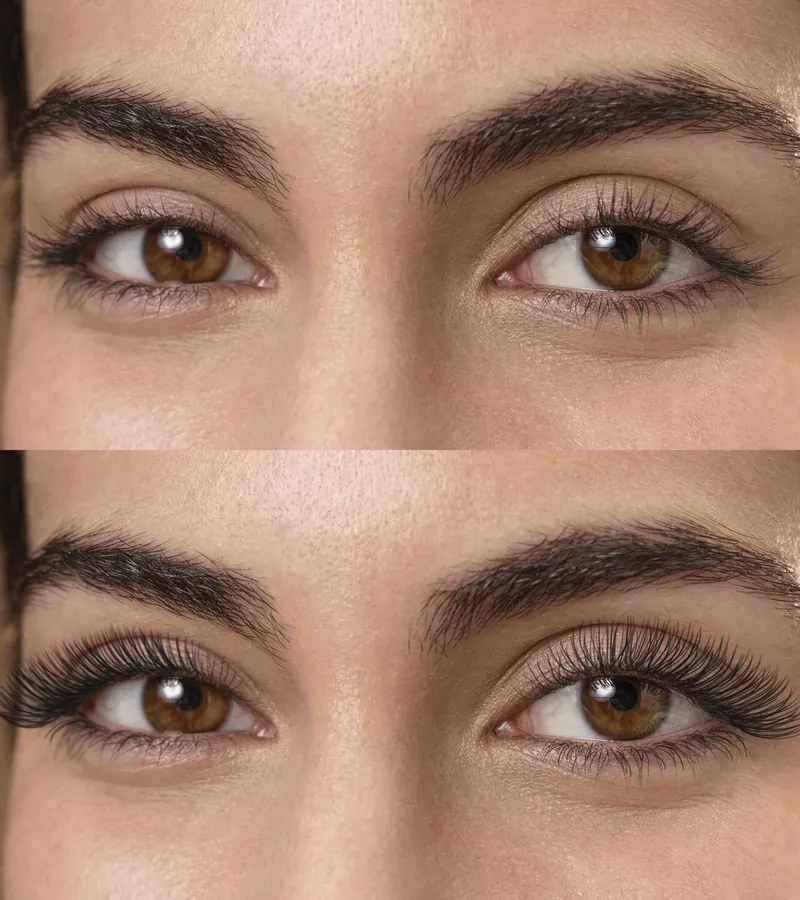
A panel of 20–30 everyday UK users runs each 8–12 week trial, with standardised photographs at weeks 0, 6 and 12. Ingredient lists are screened separately against the UK Cosmetics Regulation before anyone applies anything.
Because a ranking that only shows winners is an advert. Keeping the products we rejected visible is the point — you can see what we tested and why it did not make the cut.
Safety, regulation & ingredients
They carry documented risks: darkening of the eyelid skin, loss of fat around the eye socket and, rarely, permanent change to iris colour. In its final opinion of 2 February 2026 the EU's Scientific Committee on Consumer Safety concluded that isopropyl cloprostenate, methylamido-dihydro-noralfaprostal and dechloro dihydroxy difluoro ethylcloprostenolamide cannot be considered safe in cosmetic lash and brow products. France's ANSES issued a related cosmetovigilance alert in December 2025. We flag every serum in our ranking that contains one.
Not outright, and that is the problem. The UK's Office for Product Safety and Standards, working with the MHRA, commissioned analysis in 2024 that confirmed these ingredients are present in lash serums sold here, and regulatory positions are still moving. Until the law catches up, reading the INCI list yourself is the only reliable protection.
Scan for the letters prost. Isopropyl cloprostenate is the most common, but ethyl tafluprostamide, ethylcloprostenolamide, norbimatoprost, dehydrolatanoprost and bimatoprost all count. One to know that hides from that test: Black Sea Rod Oil, a coral extract used as a “hormone-free” active, which is one of the richest natural prostaglandin sources known — and ethyl tafluprostamide and dechloro dihydroxy difluoro ethylcloprostenolamide are two names for the same compound, which is worth knowing when a label uses the less familiar one. Marketing words such as 'clinical strength' or 'rapid growth' are a prompt to check, not a warning in themselves.
Not for a cosmetic one. Bimatoprost — the licensed prostaglandin used to grow lashes — is a prescription-only medicine in the UK and should be obtained and monitored through a prescriber. It is not an ingredient that belongs in a product sold over the counter as a cosmetic.
Peptides such as biotinoyl tripeptide-1, supported by panthenol, biotin and hyaluronic acid, have the best balance of evidence and safety. They strengthen and condition rather than force a longer growth phase, so results build gradually and the eye area is left alone.
Usually yes, with a fragrance-free, prostaglandin-free formula. Patch-test on the inner forearm for two nights, take lenses out before applying, and let the serum dry fully. Several serums in our ranking are specifically rated for sensitive eyes.
Ask your midwife, GP or pharmacist first. We do not test on pregnant participants and cannot give clinical advice, so we would rather you got an answer from someone who can.
Stop using it. If symptoms persist or affect your vision, see your GP or optometrist. Suspected side effects from a cosmetic sold in the UK can also be reported to your local Trading Standards service, which is how patterns get spotted.
Using a serum
Six to twelve weeks of nightly use for most well-formulated serums. Prostaglandin formulas act faster; peptide and conditioning formulas build gradually. Anything promising a transformation in a fortnight is describing mascara.
One stroke along the upper lash line at night, on clean, dry skin, much like a liquid eyeliner. Never on the lower lash line or in the eye. A little goes a long way — a 3 ml tube typically lasts about three months.
No. Lash serums maintain results only while you use them. Once you stop, lashes return to their natural state over one to two months, which is why cost per month matters more than the price on the box.
Many serums work on brows too, and we note which ones in the ranking. Apply sparingly along the brow line and follow the same nightly routine.
Peptide serums and conditioners are generally fine and can help the natural lash underneath. Avoid oils — they break down the adhesive and will cost you the extensions.
Buying in the UK
Roughly £15–£25 for a nourishing oil, £12–£30 for a conditioner, £35–£60 for a peptide serum and £60–£100 for a premium growth serum. Divide by two to three months of use to get the figure that actually matters.
Buy from the brand's own UK store or an established retailer. Check the packaging carries a responsible person address in the UK or EU and a batch code, and treat a price far below everyone else's as a warning rather than a bargain.
No. There are no adverts, no affiliate links, no sponsored placements and no commission of any kind. Every product is bought at full UK retail price out of our own pocket, and we do not accept PR samples, gifted products or brand partnerships. We also collect nothing about you — no cookies, no analytics, no email list. Read how this works.
Under the Consumer Contracts Regulations you generally have 14 days to cancel an online order, though sealed cosmetics that have been opened may be excluded on hygiene grounds. If a product is faulty or not as described, the Consumer Rights Act 2015 applies regardless. Check the retailer's policy before you buy.
Still not sure which serum?
Two starting points: QUALASH if you want the fastest visible results and have read our note on its ingredients, or The Ordinary Multi-Peptide at £16 if you would rather avoid prostaglandin analogues entirely — only three of the fifteen products we ranked are free of them once natural prostaglandin sources are counted alongside synthetic analogues.